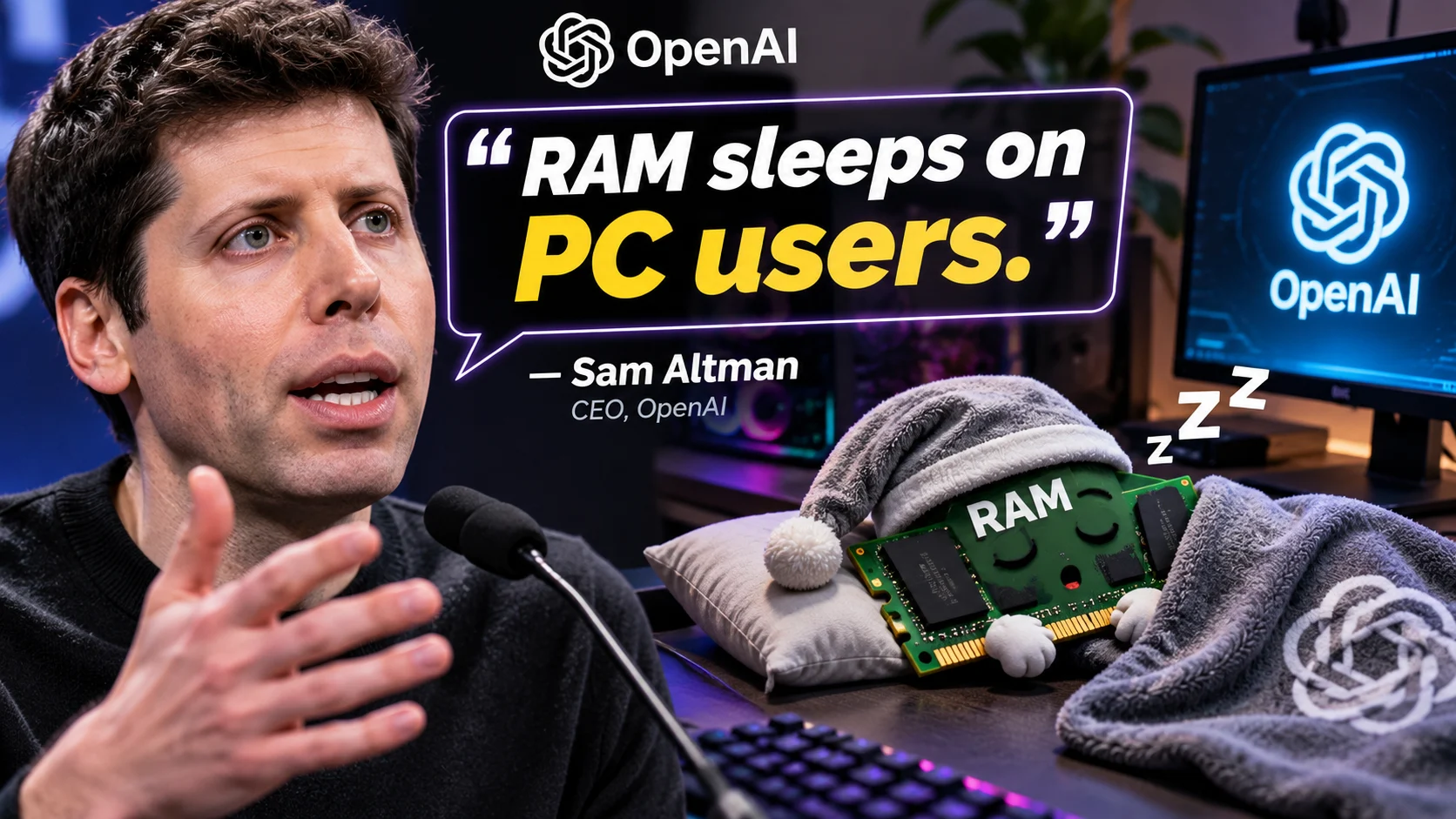
During a recent appearance on the Cheeky Pint podcast, OpenAI CEO Sam Altman made a statement that immediately set off alarm bells across the PC building, gaming, and developer communities. According to Altman, having high-speed memory sitting inside personal computers is an inefficient use of the planet's limited silicon supply.
"From a global allocation perspective, it's quite terrible to have everybody have a bunch of the world's limited supply of DRAM sitting in their own computer... If people only use it 5% of the time, that's not good."
- Sam Altman on podcast discussions regarding global compute and memory bottlenecks
The argument sounds straightforward on paper to a cloud executive: memory is scarce, AI models need massive bandwidth, and if your desktop is not running at 100% load around the clock, that memory is allegedly "sleeping." But for anyone who values local computing, consumer ownership, and software independence, Altman's perspective reveals a much more concerning vision for the future of personal tech.
The Real Threat: How Data Centers Are Starving PC Hardware
To understand why PC users are so frustrated with this narrative, you have to look at what has been happening in semiconductor foundries over the past 24 months. Semiconductor giants like SK Hynix, Samsung, and Micron have shifted substantial proportions of their advanced fabrication lines away from standard consumer DDR5 and GDDR6 modules toward High-Bandwidth Memory (HBM3e and upcoming HBM4).
Why? Because hyperscalers and AI infrastructure firms pay enormous premiums for HBM stacks packed onto Nvidia H100s, B200s, and custom enterprise accelerators. A single AI server rack can generate higher profit margins than thousands of consumer RAM kits sold to desktop builders.
The consequence for regular consumers is immediate:
- Memory pricing spikes: Consumer DRAM and SSD NAND pricing has seen artificial pressure and price hikes as wafer capacity is redirected to enterprise data centers.
- VRAM stagnation on graphics cards: Mid-range GPUs continue to launch with 8GB or 12GB of VRAM because allocating 16GB or 24GB to affordable graphics cards cuts into high-margin enterprise memory allocations.
- Supply bottlenecks: Upgrading a workstation or gaming rig with 64GB or 128GB of reliable, high-frequency DDR5 is becoming substantially more expensive.
Why Personal RAM Is Not "Wasted"
The idea that local computer memory is wasted because you are not pinning it to 100% capacity at every second of the day completely misunderstands the entire point of personal computing.
RAM is not meant to be continuously redlined like an industrial electrical turbine. Personal RAM exists to provide instantaneous headroom, zero-latency responsiveness, and complete data privacy.
Local Privacy & Data Security
When you process data, edit video, compile code, or run a local offline tool, your private files stay in your local memory. You do not need to transmit confidential photos, telemetry, or source code to an external cloud server.
Zero Latency & Frame Pacing
Whether you are rendering a 4K timeline in DaVinci Resolve or playing a demanding open-world title, RAM ensures that assets, frame buffers, and shaders are instantly accessible without buffering or network bottlenecks.
The "Centralize Everything" Trap
What makes Altman's rhetoric particularly telling is the push against running open-weight AI models locally on your own machine. Over the past year, running open models like Llama, Mistral, and DeepSeek locally on a Mac Studio, high-end PC, or custom workstation has given developers real power. It allows programmers and creators to build AI-assisted tools completely offline without paying API token costs or accepting centralized censorship.
If big-tech cloud providers convince the public that having 32GB or 64GB of RAM in a desktop is a "wasteful global allocation," the logical endpoint is a world where nobody owns capable hardware. In that model, every PC is reduced to an underpowered thin client, streaming compute over the internet while you pay recurring monthly subscriptions for access to memory pools that you used to own on your desk.
Even Elon Musk pushed back against Altman's podcast statement, remarking on X: "The people deserve to have their RAM too!"
MRK's Verdict: Defend Local Computing
As someone who builds offline-first applications and tests software on personal hardware, my stance is clear: your RAM is yours.
Having unused RAM headroom on your desktop is not a failure of global planning; it is the reason your operating system does not crash when you open twenty browser tabs while compiling a project and running an offline model in the background. The AI data center boom should not come at the expense of consumer hardware freedom. PC builders, gamers, and local developers built the digital ecosystem, and our hardware belongs in our hands.